
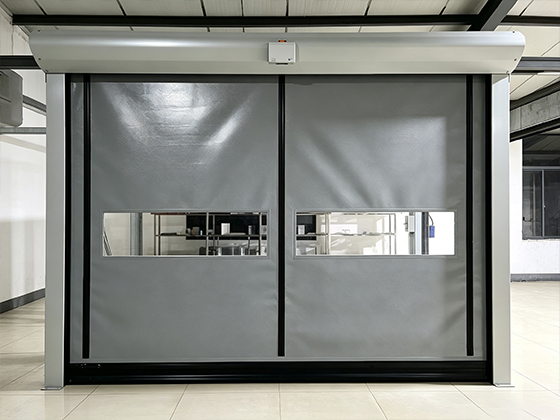
When choosing a high speed industrial door, should you invest in a Self Repairing Zipper Door or stick with a traditional high speed door? The answer depends on your traffic volume, operating environment, maintenance expectations, and budget.
Both options support efficient access, but their curtain structures and recovery mechanisms can differ significantly. Let’s compare them to help you make the right purchasing decision.
What Is a Self Repairing Zipper Door?
Zipper Curtain Design
A self repairing zipper door uses flexible curtain edges that engage with specially designed side guides. If a suitable impact dislodges the curtain, the system is designed to help it re-engage during a subsequent operating cycle.
Why Does Self-Repairing Matter?
In busy warehouses, forklifts and trolleys can occasionally contact door curtains. Automatic re-engagement may reduce manual repositioning and help operations resume sooner.
However, severe impacts or damaged components may still require professional inspection and repair.
What Is a Traditional High Speed Door?
Standard Curtain and Guide Structure
Traditional high speed doors commonly use flexible PVC curtains guided by side tracks. Their exact design varies by model, application, and manufacturer.
Typical Applications
These doors are widely used in factories, warehouses, and internal industrial passages where fast access and separation between working areas are important.
Self Repairing Zipper Door vs Traditional High Speed Door
1. Curtain Retention and Recovery
The zipper-style edges of a self repairing door are designed to improve curtain retention and support re-engagement after certain displacements.
A traditional high speed door may require manual repositioning if its curtain leaves the guides, depending on its design.
Which Is Better for Busy Facilities?
If your facility experiences frequent vehicle movement, a self repairing model may help reduce certain collision-related interruptions. For lower-traffic openings, a traditional model may be sufficient.
2. Downtime and Maintenance
Self repairing doors can reduce manual intervention after recoverable impacts. However, they still need routine inspection of curtain edges, guides, motors, and safety devices.
Traditional doors may have a simpler configuration, depending on the model, but curtain displacement can require service before normal operation resumes.
3. Sealing Performance
Zipper-style curtain edges can help reduce side gaps when correctly installed. Traditional high speed doors can also provide effective separation through suitable curtain and guide designs.
For cold storage, clean production, or dust-sensitive environments, compare documented sealing performance rather than relying on the door category alone.
4. Operating Speed and Traffic Flow
Both door types can operate at high speed. Actual performance depends on the motor, control system, opening dimensions, and selected configuration.
Check opening and closing speeds alongside expected daily cycles to ensure the door matches your workflow.
5. Initial Price and Long-Term Cost
A self repairing zipper door may have a higher initial price because of its specialized curtain and guide design. A traditional high speed door may offer a more economical solution for less demanding applications.
Consider the complete cost of ownership, including maintenance, spare parts, downtime, and expected service life.
Which Door Should You Choose?
1. Choose a Self Repairing Zipper Door If…
- Your facility has frequent forklift or trolley traffic.
- Reducing manual curtain repositioning is important.
- You need a door designed for repeated industrial operation.
- Operational interruptions create significant costs.
2. Choose a Traditional High Speed Door If…
- Your application has relatively straightforward operating requirements.
- Your traffic volume is moderate.
- Your project prioritizes a practical configuration and initial budget.
Check Before You Order
Confirm dimensions, curtain materials, operating frequency, safety features, warranty terms, and spare-part availability with your supplier.
Why Choose VelocityDoor?
Factory-Oriented Supply and OEM/ODM Support
VelocityDoor is established in 2008. We serve international distributors, contractors, and industrial buyers with industrial door solutions and customization support.
Our team can review your opening dimensions, traffic conditions, and project requirements to help identify suitable configurations.
Explore Our Other Industrial Door Products
Our product range also includes:
- PVC High Speed Doors for factories and warehouses
- Spiral High Speed Doors for fast operation and rigid panels
- High Speed Stacking Doors for large industrial openings
- High Speed Freezer Doors for cold storage facilities
- Industrial Sectional Overhead Doors for industrial buildings
- Loading Dock Levelers for loading and unloading operations
Contact Us for the Right Industrial Door
The best door is not necessarily the most advanced or the cheapest. It is the one that matches your traffic, operating conditions, maintenance expectations, and budget.
With manufacturing experience, factory-oriented supply, and OEM/ODM support, VelocityDoor works with international B2B customers to explore suitable industrial door solutions.
Contact us today with your door dimensions, application, order quantity, and destination country. Our team will help you evaluate your options and request a quotation for your next project.